Research
How does a changing climate alter the way trees grow, function, and survive? I study this question across timescales, from gradual shifts in average conditions to droughts, heat extremes, and their persistent effects. My work combines ecological and climate time-series analysis, statistical and machine-learning models, and dynamical-systems approaches, drawing on dendrometer records, flux-tower data, global tree-ring archives, and high-resolution climate datasets.
Disentangling soil and atmospheric drought
Drought stress in trees can arise from both declining soil water availability and increasing atmospheric water demand. These two forms of drought act through different pathways but often occur together, making their effects difficult to separate.
In a semi-arid pine forest, I used high-resolution dendrometer measurements together with an irrigation experiment that relieved soil drought while leaving atmospheric conditions unchanged. This allowed me to separate the effects of atmospheric drought alone from those of combined atmospheric and soil drought on daily stem growth, contraction, and recovery. During periods of high atmospheric water demand, trees with sufficient soil water continued to grow, although at a reduced rate. When high atmospheric demand coincided with soil drought, growth stopped and stems instead contracted.
Losses outlast gains: a century of tree growth under climate change
Under climate change, will forests grow more or less? Tree-growth responses vary across regions and climatic conditions, making them difficult to generalize. To trace these responses, we learned nonlinear climate–growth relationships from 4,110 Northern Hemisphere tree-ring chronologies recorded since 1902 — more than 12 million ring-width measurements — and projected them through the twenty-first century under CMIP6 climate scenarios.
Two findings stand out:
Across the Northern Hemisphere, projected growth declines, driven by warming and rising atmospheric water demand whose negative effect outweighs the gains from changing precipitation.
The response is asymmetric in time: once losses emerge they are rarely reversed, whereas gains tend to fade. The pattern holds in every well-sampled region and strengthens under stronger warming. This asymmetry reflects the nonlinear climate–growth response: warming can initially favor growth in colder, low-demand climates, but continued warming and rising atmospheric demand erode those gains.
Read the preprint on bioRxiv → · PDF
Drought history and tree survival
Drought can damage a tree’s water-transport system and deplete the carbon available for maintenance and rebuilding, potentially leaving it more vulnerable to the next drought. But drought can also reduce its canopy, lowering water demand and potentially making it more tolerant of a subsequent drought—even compared with an otherwise identical tree that had not experienced the first event. Whether the legacy is harmful or protective depends on how these effects interact and change over time.
I am using dynamical systems to study this balance in a minimal model linking carbon availability, hydraulic function, and canopy. These components respond and recover at different rates, so the interval between droughts changes the physiological state on which the next event acts. The project asks when a previous drought leaves a tree more vulnerable, when it creates a protective advantage, and how that advantage can emerge or disappear between events.
Where the tree-ring record can speak for a changing climate
The International Tree-Ring Data Bank is the largest archive of tree-ring records on Earth and a major resource for dendroclimatology. But its sites were assembled for many purposes, often to capture strong climate signals rather than to represent the full range of climates occupied by forests. This project quantifies how well the archive samples that multidimensional climate space, where coverage is dense or sparse, and how that coverage changes as the climate warms.
Three questions sit at its core:
Climatic representation: how well does the tree-ring network represent the climates occupied by forests globally? I compare the distribution of tree-ring sites with global forest cover in multidimensional climate space, identifying where that space is well sampled and where important gaps remain.
Space-for-time substitution: a common assumption in climate-change ecology is that spatial climate gradients can inform responses to change through time. I examine where the existing network provides suitable climatic analogs for this approach, and where that assumption becomes less well supported.
Novel climates: as climate change shifts forests toward new combinations of conditions, some may move beyond the climate space represented in the existing record. Mapping these emerging gaps shows where inference becomes more uncertain and where additional sampling could be most valuable.
Revealing whole-tree dynamics through time-lapse video
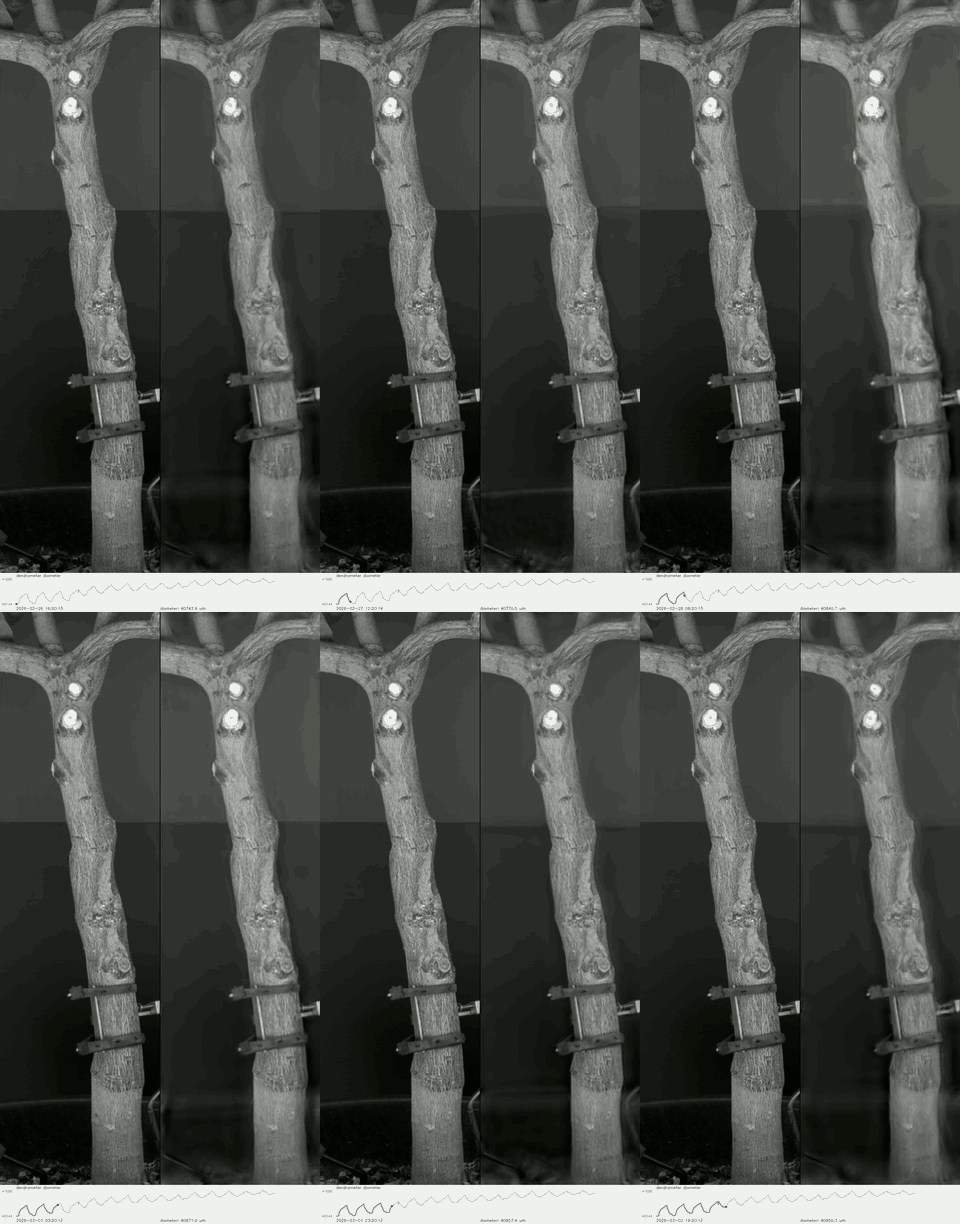
Exploratory work — preliminary example.
Can time-lapse video reveal otherwise invisible dynamics of the whole tree? Dendrometers are widely used to track stem growth and shrinkage, but each sensor measures changes at a single location. I am exploring whether time-lapse video and motion amplification can extend these local observations to the whole tree, revealing how the stem, branches, and canopy move together. By pairing video with dendrometer measurements, I aim to connect these movements to tree water status and environmental forcing. The preliminary example below focuses on the stem.
Future directions
Across my work, I am interested in how vegetation responds to environmental change across scales, from short-term physiological responses of individual plants to long-term changes in ecosystem structure and function. My current research has focused largely on trees and on how climatic variability and drought affect growth, recovery, and longer-term trajectories. I now want to extend these questions more broadly to understand when vegetation responses are reversible, when stress leaves persistent legacies, and when repeated or interacting disturbances reorganize ecosystems.
I am particularly interested in how interactions among climate, plant function, and disturbance shape these changes, and how their effects propagate to ecosystem carbon and water cycling. I aim to bring together long-term observations, remote sensing, and large-scale data analysis with process-based and dynamical systems models to investigate the processes and feedbacks that shape vegetation dynamics across scales.
I am seeking postdoctoral opportunities beginning fall 2027 to develop this research further.